
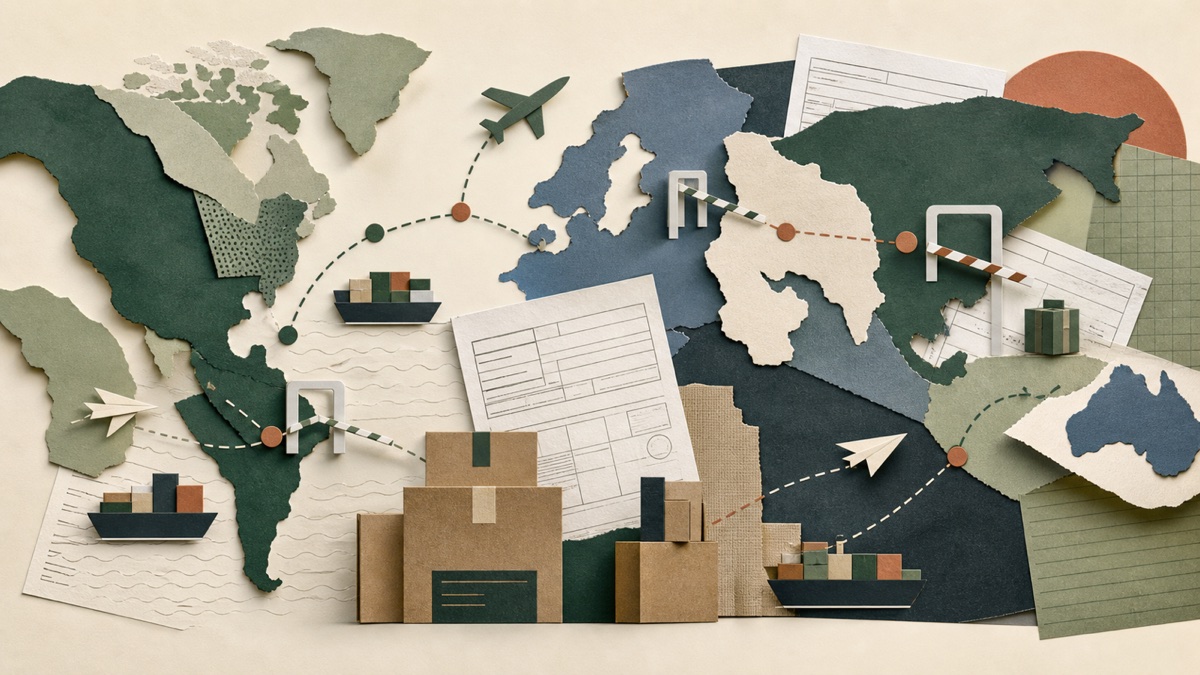
Cross-border tax is a transaction-flow problem, not simply a rate lookup. The seller, platform, customer location and status, product type, shipment route, consignment value, importer of record, and delivery terms can change who registers, who collects tax, and what the customer pays at the border.
Key takeaways
Separate consumption tax from customs duty and carrier fees.
Determine the deemed supplier or responsible platform.
Use reliable customer and shipment evidence.
Explain at checkout whether import charges are prepaid or due on delivery.
Map the legal and physical transaction flow
US merchants shipping eligible small parcels to EU consumers can use the IOSS guide for US sellers to separate import VAT, intermediary responsibilities, and the July 2026 customs duty.
Identify the contracting seller, payment recipient, platform, ship-from country, ship-to country, customer status, product type, warehouse, carrier, importer of record, and Incoterm or delivery arrangement.
Digital services have no parcel but still require customer-location and B2B/B2C analysis. Physical goods add customs value, origin, commodity classification, duty, import VAT or GST, and border documentation. Treat these as two related but different workflows.
Draw four flows: the goods or service, the customer payment, the invoice, and the tax or customs data. When they involve different legal entities or systems, gaps become visible—for example, the storefront promises prepaid duties while the carrier records the customer as importer.
- Diagram money, invoice, data, and goods flows.
- Separate merchant and platform responsibilities.
- Record who is importer of record.
- Identify the system that provides customs and tax data to the carrier.
Use EU OSS and IOSS in the right context
The EU One Stop Shop can simplify reporting for qualifying cross-border B2C supplies, while the Import One Stop Shop is designed for qualifying imported consignments not exceeding €150. These schemes do not eliminate product-rate, customer-location, or recordkeeping analysis.
From July 1, 2026, the EU applies a temporary €3 customs duty per item category in low-value consignments entering through the IOSS flow until the broader customs reform planned for July 2028. This customs charge is separate from VAT.
- Confirm whether OSS, non-Union OSS, or IOSS applies.
- Capture destination-country VAT treatment.
- Model the 2026 low-value customs charge separately from VAT.
Test Canada GST/HST registration
Canada’s simplified cross-border digital economy rules can require a non-resident seller or platform to register when relevant taxable supplies to specified Canadian recipients exceed C$30,000 over a 12-month period.
The applicable system depends on the supplies, customer status, location, and whether a platform is responsible. Collect business and registration information where relevant and preserve the evidence used to determine the customer’s province.
- Monitor the C$30,000 test using the correct revenue scope.
- Separate consumer and registered-business transactions.
- Map GST/HST rate treatment by place of supply.
Separate VAT or GST from customs costs
VAT or GST, customs duty, excise, brokerage, disbursement, and carrier handling fees are different charges. A low-value VAT simplification does not necessarily remove customs obligations.
Checkout should say whether duties and import taxes are included, prepaid, estimated, or payable on delivery. The operational promise must match carrier data and the importer-of-record arrangement.
- Classify goods and establish customs value.
- Choose and document delivery terms.
- Avoid calling all border charges “tax.”
Build evidence, reconciliation, and change control
Retain orders, invoices, product classification, customer-location indicators, business status, platform statements, customs declarations, carrier adjustments, exchange rates, returns, and tax reports. Resolve conflicting location evidence through a documented rule.
Reconcile checkout tax to platform filings, customs entries, carrier invoices, and accounting. Cross-border programs should be reviewed when sales enter a new country, a threshold approaches, fulfillment moves, or law changes.
- Version rates and legal rules by effective date.
- Reconcile platform, tax, and customs data separately.
- Give customers a clear refund and import-charge process.
Design a transparent international checkout
Before the customer pays, display the product price, VAT or GST, shipping, duties, and carrier or brokerage charges as accurately as the model permits. If an amount is only an estimate, say so. If charges will be collected on delivery, explain who may contact the customer and what can happen if the parcel is refused.
Choose a consistent delivered-duty-paid or delivered-at-place experience by lane rather than letting storefront copy, carrier labels, and contracts contradict one another. The importer-of-record decision must be operationally supported by registrations, customs data, and carrier instructions.
For digital products, collect enough evidence to determine customer location and status without adding unnecessary friction. Validate business tax identifiers where the regime requires it and retain the evidence behind the VAT or GST treatment.
- Show included and excluded charges before payment.
- Avoid calling duties, VAT, and brokerage one generic “tax.”
- Align checkout promises with carrier setup.
- Provide a clear refused-delivery and refund policy.
Plan registrations and filings by market
Create a country matrix covering supply type, threshold, measurement period, registration scheme, platform responsibility, rate source, invoice requirement, filing frequency, payment currency, record-retention rule, and local adviser. Prioritize markets by revenue, exposure, and operational complexity.
Simplified regimes such as OSS, IOSS, or Canada’s simplified GST/HST system can reduce registration burden, but they have scope limits. A business may still need a normal registration for local inventory, B2B activity, imports, or other supplies.
Monitor exchange rates and threshold calculations in the required currency. Preserve how foreign-currency sales were converted and reconcile filed returns to the underlying order, platform, and payment data.
- Separate simplified and normal registration obligations.
- Track thresholds using the correct currency and revenue scope.
- Add every filing and payment deadline to one calendar.
- Review the matrix before entering a new market or warehouse.
Frequently asked questions
Are VAT or GST and customs duties the same?
No. Consumption tax and customs duty are separate charges with different bases, rules, and responsible parties.
What is the EU IOSS consignment limit?
IOSS is designed for qualifying imported consignments with an intrinsic value not exceeding €150.
When can Canada require a non-resident digital seller to register?
Under the simplified cross-border rules, the threshold is generally more than C$30,000 of relevant supplies over a 12-month period, subject to the detailed scope rules.
What does importer of record mean?
The importer of record is the party responsible for the customs entry and associated import obligations. The commercial and carrier setup must clearly identify that party; it should not be inferred from marketing copy alone.
Does using a marketplace remove international tax duties?
Not automatically. A platform may be treated as the supplier for covered transactions, while the merchant retains obligations for direct sales, excluded goods or services, inventory, records, and other taxes.
Official sources
Reviewed against the following primary sources on Aug 8, 2026.