
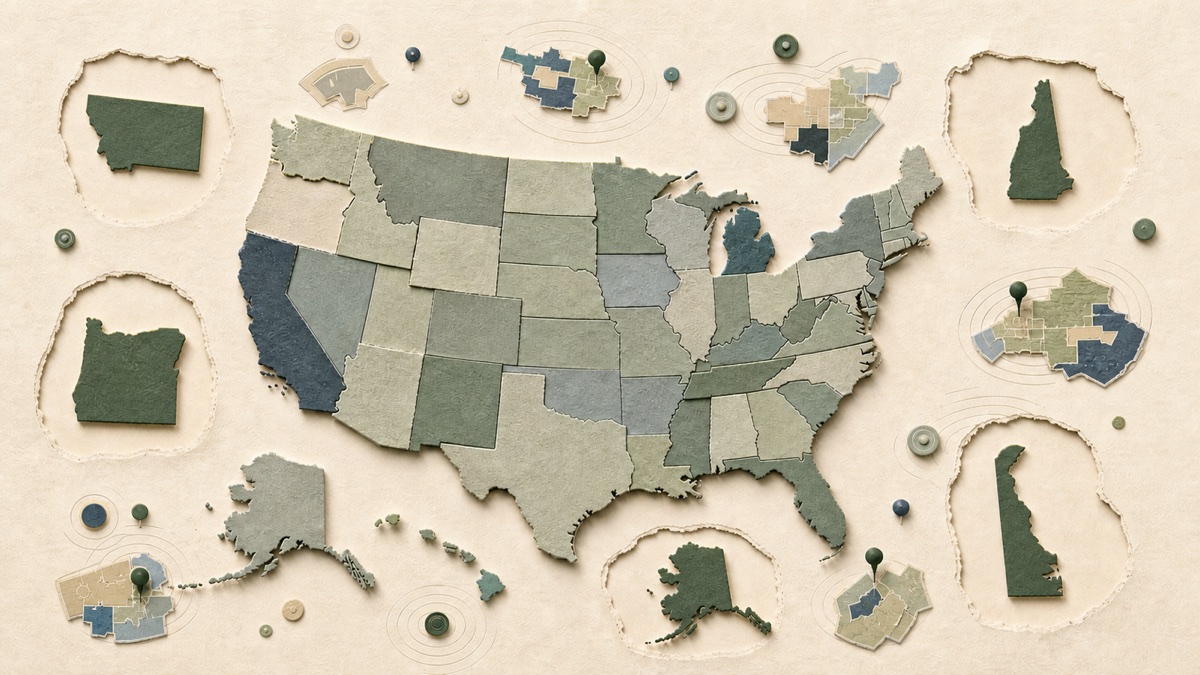
Five states have no general statewide sales tax in 2026: Alaska, Delaware, Montana, New Hampshire, and Oregon. The familiar list is useful, but it is often repeated without the part that matters in practice. Alaska allows local sales taxes, Delaware imposes gross receipts tax on many businesses, and several of these states tax particular activities or products through systems that are not called a general sales tax.
Key takeaways
The five-state list is Alaska, Delaware, Montana, New Hampshire, and Oregon.
Alaska has no statewide sales tax, but many local governments impose one.
No general sales tax does not eliminate business, lodging, meals, vehicle, excise, or other taxes.
A seller based in one of these states can still owe collection duties in customer states.
The five-state list—and the wording that matters
When people say a state has “no sales tax,” they usually mean no broad statewide tax added to ordinary retail purchases. That description fits Alaska, Delaware, Montana, New Hampshire, and Oregon. It does not promise that a hotel room, prepared meal, rental, vehicle, alcohol purchase, or business receipt will escape every state or local charge.
The word statewide is especially important for Alaska. The state government does not impose a sales tax, but Alaska’s Department of Commerce explains that local municipalities may levy sales and use taxes. A receipt in Juneau or another participating locality can therefore look very different from a purchase elsewhere in the state.
For sellers, the list is not a substitute for nexus analysis. A business headquartered in Portland, Oregon may have no Oregon general sales tax to collect, yet it can still cross a remote-seller threshold in Washington, California, Texas, or another customer state.
- Alaska: no state sales tax; local taxes may apply.
- Delaware: no state or local sales tax; gross receipts tax may apply to sellers.
- Montana: no general-use sales tax.
- New Hampshire: no general sales tax; targeted taxes still exist.
- Oregon: no general sales or use tax.
Alaska is the exception shoppers notice at checkout
Alaska is frequently placed on the no-sales-tax list, and that is correct at the state level. Local governments, however, can adopt their own sales and use taxes. The rate, taxable items, exemptions, caps, seasonal rules, registration, and filing can vary by locality.
An online seller should not set Alaska to zero across the board merely because a tax table labels it a no-tax state. The delivery address needs to be checked for an applicable local jurisdiction, and the seller must determine whether its facts create a local collection obligation. Alaska also has a coordinated remote-seller system used by participating local governments, so remote commerce requires current, address-level review.
For a buyer, the practical lesson is simple: “shipping to Alaska” does not guarantee a zero-tax checkout. For a merchant, it means the state field alone is too broad to produce a reliable answer.
- Validate the full Alaska delivery address.
- Check whether the locality participates in remote collection.
- Do not reuse one rate for every Alaska ZIP code.
- Keep local registration and return duties in the compliance calendar.
Delaware replaces the checkout tax with a different business question
Delaware does not impose a state or local sales tax on the customer. That is why it is famous for tax-free retail shopping. The absence of a line-item sales tax does not mean a Delaware business operates free of transaction-based taxes.
The Delaware Division of Revenue explains that businesses may owe gross receipts tax on total receipts from goods sold and services rendered in the state. The tax is imposed on the seller, with rates and exclusions that depend on business activity. It is not presented as a customer sales tax to be passed through as a separate checkout line.
A retailer should therefore keep two questions separate: “Do I charge the Delaware customer sales tax?” and “Does my Delaware activity create a gross receipts tax or licensing obligation?” Answering no to the first does not answer the second.
- Do not add a Delaware sales-tax line to an ordinary retail sale.
- Classify the business activity for gross receipts purposes.
- Review licensing, filing, and exclusion rules independently.
- Do not describe gross receipts tax as customer sales tax.
Montana has no general-use sales tax, but sellers still look outward
Montana’s Department of Revenue states that the state does not have a general-use sales tax. That makes many everyday purchases straightforward inside Montana, though the state and local governments can still impose taxes or fees on specific products, accommodations, tourism-related activity, alcohol, tobacco, cannabis, vehicles, or other regulated categories.
A Montana online store cannot stop its tax review at the business address. The department specifically reminds Montana sellers that online sales to customers in other states may require collection under those states’ laws. The delivery destination, physical presence, and economic nexus thresholds matter.
This is a common source of confusion for small businesses. “We are located in a no-sales-tax state” describes the home-state system; it does not provide an exemption from every destination state where the company sells.
- Confirm whether a product falls under a special Montana tax.
- Track sales by customer destination.
- Review physical and economic nexus outside Montana.
- Register before collecting in another state when required.
New Hampshire’s general rule has targeted exceptions
New Hampshire’s Department of Revenue Administration answers the headline question directly: the state does not have a general sales tax. Ordinary retail purchases therefore do not carry the broad state sales tax seen in many neighboring states.
The state does administer narrower taxes and licenses, including the Meals and Rooms tax and taxes connected with particular business activities. A restaurant meal, hotel stay, motor-vehicle rental, or other covered transaction should not be analyzed from the no-general-sales-tax slogan alone.
Merchants should classify the sale before deciding that no New Hampshire tax applies. Shoppers comparing prices should also compare the final transaction, not just the state’s general sales-tax status.
- Separate retail goods from meals, rooms, and rentals.
- Check the current license and filing requirements for the activity.
- Use the official tax program page rather than a generic state-rate chart.
- Avoid advertising every New Hampshire purchase as universally tax-free.
Oregon has no general sales tax, with limited transaction taxes
Oregon says it has no general sales or use tax based on the transaction amount. That is the reason a normal retail receipt in Oregon usually has no sales-tax line. The state still calls out specific programs, including vehicle privilege and use taxes, and businesses remain subject to other state and local obligations.
Oregon’s guidance also points outward: Oregon businesses selling into a state with a sales tax may need to register and collect there. A shopper ordering from an Oregon company does not inherit Oregon’s tax treatment when the product is delivered to a taxable destination in another state.
The cleanest system keeps home-state and destination-state rules separate. The merchant’s warehouse address may explain where the order starts; it does not necessarily determine where sales tax is due.
- Treat “no general tax” as a defined rule, not a universal exemption.
- Review vehicle and other special programs separately.
- Source interstate orders to the proper destination.
- Monitor customer-state nexus even when the seller is Oregon-based.
What a shopper should check before planning a purchase
Traveling to a no-sales-tax state can reduce the tax paid at the register on an ordinary taxable product, but the full picture depends on the item, delivery, and home-state use-tax rules. Having a store ship the product to your home can change the transaction’s sourcing. Bringing a large purchase home may also create a use-tax obligation in the home state even if the seller did not collect it.
Warranties, returns, shipping costs, travel costs, and local or product-specific taxes can erase part of the expected saving. A lower checkout total is real; it is simply not proof that no other tax rule applies.
For high-value purchases, keep the invoice and delivery records and check the destination or home-state guidance. A retailer’s cashier is not responsible for giving the buyer personal tax advice.
- Compare the final delivered price.
- Check whether the product has a special tax.
- Understand home-state use tax on out-of-state purchases.
- Keep proof of tax paid or exemption claimed.
What an online seller should configure
Do not create one hard-coded “no-tax states” rule. Alaska needs local address logic, and all five states require product-specific checks for targeted taxes. More importantly, orders shipped out of those states may be taxable at the destination.
Maintain separate records for nexus, registration, sourcing, taxability, customer exemptions, and marketplace collection. A marketplace may handle tax on its orders while the seller remains responsible for direct website sales elsewhere. Test a local Alaska address, an interstate order from Oregon, and returns that change the taxable amount.
Review the configuration at least annually and when a locality, product line, warehouse, or sales channel changes. The five-state list is stable enough for a quick fact, but a production checkout needs current official rules and transaction-level evidence.
- Avoid state-level zero-rate overrides for Alaska.
- Monitor destination-state thresholds for direct sales.
- Keep marketplace and direct orders separate.
- Version special-tax and local-jurisdiction rules.
Frequently asked questions
What are the five states with no general statewide sales tax?
Alaska, Delaware, Montana, New Hampshire, and Oregon. Alaska is unusual because local governments may impose sales and use taxes.
Is everything tax-free in those five states?
No. Specific products and activities can face lodging, meals, rental, vehicle, excise, gross receipts, local, or other taxes even without a general statewide retail sales tax.
Does Alaska have sales tax?
Alaska has no statewide sales tax, but municipalities may impose local sales and use taxes. The exact delivery address matters.
Does a business in Oregon or Montana collect tax for other states?
It may. Physical presence or economic nexus in a customer state can require registration and collection under that destination state’s law.
Can buying in a no-sales-tax state create use tax at home?
Yes. A home state can impose use tax on an out-of-state purchase when sales tax was not collected, subject to its own rules and exemptions.
Official sources
Reviewed against the following primary sources on Aug 23, 2026.
- Alaska Department of Commerce — Alaska Sales Tax Information
- Delaware Division of Revenue — Gross Receipts Taxes
- Montana Department of Revenue — General Sales Tax
- New Hampshire DRA — Does New Hampshire Have a Sales Tax?
- New Hampshire DRA — Tax Licenses and Permits
- Oregon Department of Revenue — Sales Tax